Pendidikan
English Grade 3 KTsp: Semester 2

English Grade 3 KTsp: Semester 2

English Grade 3 KTsp: Semester 2

This article provides a comprehensive overview of English subject matter for third-grade students in the second semester, following the KTsp curriculum. It aims to equip educators and parents with a clear understanding of the learning objectives, topics covered, and suggested pedagogical approaches. The content is structured to be easily digestible, with a focus on clarity and practical application.

I. Introduction

The second semester of third-grade English under the KTsp curriculum builds upon the foundational knowledge acquired in the first semester. The primary goal is to further develop students’ English language proficiency, focusing on listening, speaking, reading, and writing skills. Emphasis is placed on making learning engaging and relevant to young learners, incorporating interactive activities and age-appropriate content. The KTsp (Kurikulum Tingkat Satuan Pendidikan) framework allows for local adaptation, meaning specific examples and activities might vary slightly across different educational institutions. However, the core learning objectives and thematic units remain consistent.


<p>English Grade 3 KTsp: Semester 2</p>
<p>” title=”</p>
<p>English Grade 3 KTsp: Semester 2</p>
<p>“></p>
<p><strong>II. Learning Objectives</strong></p>
<p>By the end of the second semester, third-grade students are expected to achieve the following learning objectives:</p>
<ul>
<li>
<p><strong>Listening:</strong></p>
<ul>
<li>Understand simple instructions and directions given in English.</li>
<li>Identify familiar words, phrases, and short sentences related to everyday topics.</li>
<li>Recognize and respond to basic questions.</li>
<li>Follow simple stories or narratives with visual aids.</li>
</ul>
</li>
<li>
<p><strong>Speaking:</strong></p>
<ul>
<li>Produce simple words and short phrases to express basic needs and ideas.</li>
<li>Respond to simple questions using appropriate vocabulary.</li>
<li>Engage in short, simple conversations on familiar topics.</li>
<li>Pronounce common English sounds and words with reasonable accuracy.</li>
</ul>
</li>
<li>
<p><strong>Reading:</strong></p>
<ul>
<li>Recognize and read familiar English words, including sight words.</li>
<li>Understand the meaning of simple sentences and short texts with the support of pictures.</li>
<li>Identify the main idea of a short, simple passage.</li>
<li>Develop a basic understanding of letter-sound correspondences.</li>
</ul>
</li>
<li>
<p><strong>Writing:</strong></p>
<ul>
<li>Write familiar English words legibly.</li>
<li>Copy short sentences accurately.</li>
<li>Begin to form simple sentences with guidance.</li>
<li>Express ideas through drawing and labeling.</li>
</ul>
</li>
</ul>
<p><strong>III. Thematic Units and Content</strong></p>
<p>The second semester typically revolves around several thematic units designed to introduce a range of vocabulary and grammatical structures in a meaningful context. While the exact naming of units may vary, the underlying themes are generally consistent.</p>
<p><strong>Unit 1: My School and Classroom</strong></p>
<p>This unit focuses on vocabulary and phrases related to the school environment and classroom objects.</p>
<ul>
<li><strong>Vocabulary:</strong>
<ul>
<li>Classroom objects: <em>pencil, pen, book, notebook, ruler, eraser, bag, chair, table, board, door, window.</em></li>
<li>School subjects: <em>English, Math, Science, Art, Music, Physical Education.</em></li>
<li>People at school: <em>teacher, student, friend.</em></li>
<li>Actions: <em>read, write, draw, sing, play, listen, speak.</em></li>
</ul>
</li>
<li><strong>Grammar:</strong>
<ul>
<li>This/That: <em>This is a pencil. That is a book.</em></li>
<li>Articles: <em>a, an.</em></li>
<li>Plural nouns: <em>books, pens, chairs.</em></li>
<li>Simple present tense for routines: <em>I read a book. She writes.</em></li>
</ul>
</li>
<li><strong>Activities:</strong>
<ul>
<li>Identifying classroom objects.</li>
<li>Labeling pictures of school items.</li>
<li>Singing songs about school.</li>
<li>Role-playing classroom scenarios.</li>
<li>Simple Q&A about school activities.</li>
</ul>
</li>
</ul>
<p><strong>Unit 2: My Family and Friends</strong></p>
<p>This unit expands vocabulary to include family members and introduces simple ways to talk about relationships.</p>
<ul>
<li><strong>Vocabulary:</strong>
<ul>
<li>Family members: <em>mother, father, sister, brother, grandmother, grandfather, baby.</em></li>
<li>Describing people: <em>tall, short, happy, sad, kind.</em></li>
<li>Feelings: <em>happy, sad, angry, excited.</em></li>
<li>Greetings and farewells: <em>Hello, Goodbye, Good morning, Good afternoon.</em></li>
</ul>
</li>
<li><strong>Grammar:</strong>
<ul>
<li>Possessive adjectives: <em>my, your, his, her.</em> (e.g., <em>My mother is kind. Her sister is happy.</em>)</li>
<li>"Who is this?": <em>Who is this? This is my mother.</em></li>
<li>"Have got" for possession: <em>I have got a brother.</em> (Often introduced implicitly through descriptions).</li>
</ul>
</li>
<li><strong>Activities:</strong>
<ul>
<li>Drawing family trees and labeling members.</li>
<li>Describing family members using simple adjectives.</li>
<li>Practicing greetings and farewells.</li>
<li>Singing songs about family.</li>
<li>Show and tell about a favorite toy or friend.</li>
</ul>
</li>
</ul>
<p><strong>Unit 3: Food and Drinks</strong></p>
<p>This unit introduces common food and drink items, encouraging students to express preferences.</p>
<ul>
<li><strong>Vocabulary:</strong>
<ul>
<li>Fruits: <em>apple, banana, orange, grape, watermelon.</em></li>
<li>Vegetables: <em>carrot, potato, tomato, broccoli.</em></li>
<li>Drinks: <em>water, milk, juice.</em></li>
<li>Meals: <em>breakfast, lunch, dinner.</em></li>
<li>Taste: <em>sweet, sour, salty.</em></li>
</ul>
</li>
<li><strong>Grammar:</strong>
<ul>
<li>"I like…": <em>I like apples. I like milk.</em></li>
<li>"I don’t like…": <em>I don’t like broccoli.</em></li>
<li>Quantifiers (simple introduction): <em>some, a lot of</em> (e.g., <em>I have some apples.</em>)</li>
<li>"What do you like?": <em>What do you like? I like bananas.</em></li>
</ul>
</li>
<li><strong>Activities:</strong>
<ul>
<li>Matching pictures of food with their names.</li>
<li>Creating simple food collages.</li>
<li>Playing "Guess the Food" games.</li>
<li>Discussing favorite foods.</li>
<li>Singing songs about food.</li>
</ul>
</li>
</ul>
<p><strong>Unit 4: Animals</strong></p>
<p>This unit introduces various animals, their sounds, and simple characteristics.</p>
<ul>
<li><strong>Vocabulary:</strong>
<ul>
<li>Farm animals: <em>cow, sheep, pig, chicken, horse.</em></li>
<li>Pets: <em>dog, cat, rabbit, fish.</em></li>
<li>Wild animals: <em>lion, elephant, monkey, bear.</em></li>
<li>Animal sounds: <em>moo, baa, oink, cluck, neigh.</em></li>
<li>Body parts (simple): <em>legs, tail, ears.</em></li>
</ul>
</li>
<li><strong>Grammar:</strong>
<ul>
<li>"What animal is it?": <em>What animal is it? It is a cow.</em></li>
<li>"It can…": <em>It can run. It can fly.</em></li>
<li>Pluralization of animal names.</li>
</ul>
</li>
<li><strong>Activities:</strong>
<ul>
<li>Mimicking animal sounds and movements.</li>
<li>Matching animals to their sounds.</li>
<li>Creating animal masks.</li>
<li>Singing animal-themed songs.</li>
<li>Simple storytelling about animals.</li>
</ul>
</li>
</ul>
<p><strong>Unit 5: My Body</strong></p>
<p>This unit focuses on basic body parts and actions.</p>
<ul>
<li><strong>Vocabulary:</strong>
<ul>
<li>Body parts: <em>head, eyes, nose, mouth, ears, arms, hands, fingers, legs, feet, toes.</em></li>
<li>Actions: <em>jump, run, walk, clap, wave, smile, blink.</em></li>
</ul>
</li>
<li><strong>Grammar:</strong>
<ul>
<li>"My ": <em>My head. My eyes.</em></li>
<li>"Touch your ": <em>Touch your nose. Touch your ears.</em></li>
<li>"I can ": <em>I can jump. I can run.</em></li>
</ul>
</li>
<li><strong>Activities:</strong>
<ul>
<li>Simon Says games using body parts and actions.</li>
<li>Drawing a body outline and labeling parts.</li>
<li>Singing songs like "Head, Shoulders, Knees, and Toes."</li>
<li>Action songs.</li>
</ul>
</li>
</ul>
<p><strong>IV. Pedagogical Approaches and Teaching Strategies</strong></p>
<p>Effective teaching of English to young learners in third grade requires a multi-sensory and engaging approach.</p>
<ul>
<li><strong>Visual Aids:</strong> Pictures, flashcards, charts, realia (real objects), and videos are crucial for vocabulary acquisition and comprehension.</li>
<li><strong>Auditory Learning:</strong> Songs, rhymes, stories read aloud, and dialogues help students develop listening skills and pronunciation.</li>
<li><strong>Kinesthetic Learning:</strong> Action songs, games, role-playing, and physical activities cater to the energetic nature of young learners and reinforce learning through movement.</li>
<li><strong>Interactive Activities:</strong> Pair work, group work, and whole-class participation encourage communication and collaboration.</li>
<li><strong>Storytelling:</strong> Using simple stories with clear plots and illustrations helps develop comprehension, vocabulary, and an interest in reading.</li>
<li><strong>Repetition and Recycling:</strong> Regularly revisiting vocabulary and grammar points in different contexts ensures retention.</li>
<li><strong>Positive Reinforcement:</strong> Encouraging and praising students’ efforts, regardless of the outcome, builds confidence and motivation.</li>
<li><strong>Differentiation:</strong> Recognizing that students learn at different paces, teachers should provide varied activities and support to meet individual needs. This might include providing sentence starters for writing or offering more challenging extension activities.</li>
<li><strong>Play-Based Learning:</strong> Incorporating games into lessons makes learning fun and less intimidating. Examples include Bingo, memory games, charades, and board games adapted for English learning.</li>
<li><strong>Use of Technology:</strong> Age-appropriate educational apps, interactive whiteboards, and short animated videos can enhance engagement and provide new avenues for learning.</li>
</ul>
<p><strong>V. Assessment</strong></p>
<p>Assessment in the second semester of third-grade English under KTsp should be ongoing and varied, focusing on the four skills.</p>
<ul>
<li><strong>Formative Assessment:</strong>
<ul>
<li><strong>Observation:</strong> Observing students’ participation in class activities, their ability to follow instructions, and their contributions to discussions.</li>
<li><strong>Questioning:</strong> Asking targeted questions during lessons to gauge understanding.</li>
<li><strong>Short Quizzes:</strong> Informal quizzes on vocabulary or simple grammar points.</li>
<li><strong>Activity-Based Assessment:</strong> Evaluating students’ performance in games, role-plays, and other interactive tasks.</li>
</ul>
</li>
<li><strong>Summative Assessment:</strong>
<ul>
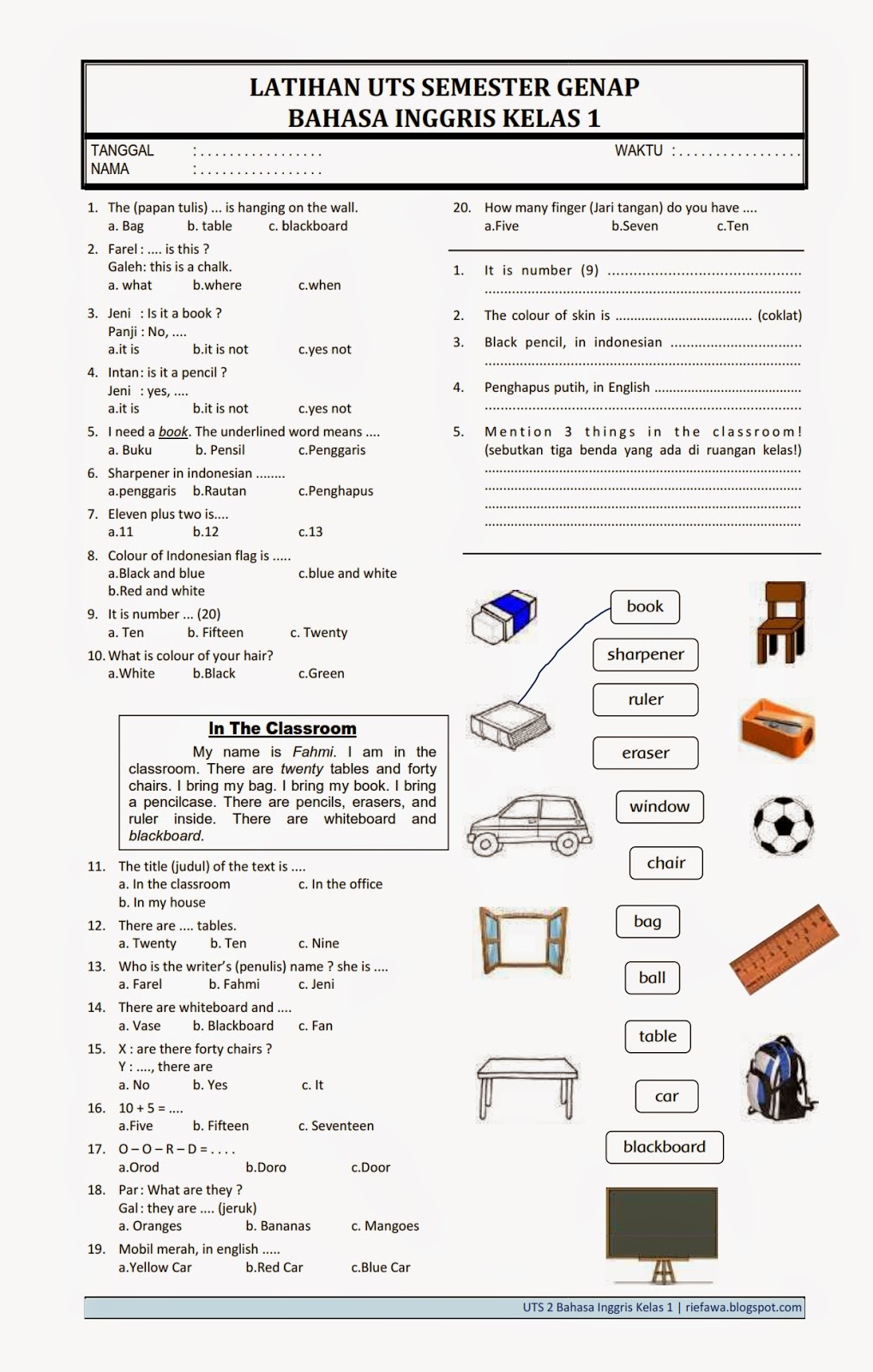
<li><strong>Unit Tests:</strong> These typically include sections on vocabulary matching, sentence completion, simple listening comprehension (e.g., matching pictures to spoken sentences), and basic writing tasks (e.g., writing words or simple sentences).</li>
<li><strong>Oral Presentations:</strong> Students might be asked to present a drawing of their family or favorite animal, using simple English sentences.</li>
<li><strong>Portfolio Assessment:</strong> Collecting samples of students’ work throughout the semester, such as drawings with labels, copied sentences, or short written pieces, can provide a holistic view of their progress.</li>
</ul>
</li>
</ul>
<p><strong>VI. Conclusion</strong></p>
<p>The second semester of English for third graders under the KTsp curriculum offers a structured yet flexible approach to language acquisition. By focusing on engaging thematic units, employing diverse pedagogical strategies, and conducting ongoing, varied assessments, educators can effectively foster a strong foundation in English for their young learners. The emphasis on creating a positive and supportive learning environment will not only enhance their language skills but also instill a lifelong love for learning English. Teachers are encouraged to adapt these guidelines to the specific needs and context of their students, ensuring that the learning experience is both effective and enjoyable.</p>

		<div class=

0

Leave a Reply

Your email address will not be published. Required fields are marked *